


In this article

Somewhere in your library is the interview you need. Its filename says who was filmed, where and when. Its collection path says which episode it belongs to. Its transcript says what was said. Unless someone copied all of that into metadata fields, you can’t filter for any of it.
That’s the everyday problem with media libraries. They hold years of footage, audio, images and project files, and how much of it gets reused depends largely on whether people can find the right asset when they need it. For most teams, finding still comes down to metadata, and metadata is the thing nobody has time to fill in. That makes it an obvious job for AI. The question is how to apply it, because the approaches come with very different costs.
One approach to AI in media is to analyze the footage itself: identify the faces, objects, scenes and activities in every video. For some questions, that’s exactly the right tool. But this can be expensive at scale, and much of the metadata teams need day to day, such as the episode, summary, project code, guest or campaign, is already sitting in the library, just like the details of that interview. Analyzing the footage itself can hike compute cost without adding much information.
At Iconik, we believe AI in media should start with the context that’s already available. It should put the knowledge a team already has to work, take direction from the people who know the library best, connect to the tools teams already use, follow the same permissions as everything else, and deliver real value without unnecessary cost.
Our latest innovations, including AI metadata enrichment and the Iconik MCP, are built on that thinking. AI metadata enrichment turns the context a library already holds into metadata people can filter on. The Iconik MCP server lets users describe what they need and then let the AI assistants teams already use work with that library, under each user’s own permissions.
Better metadata from context you already have
AI metadata enrichment starts from a simple observation: there's often more known about an asset than its metadata fields show. No team can describe media by hand at the rate it's now created. That's an operational problem before it's an AI one.
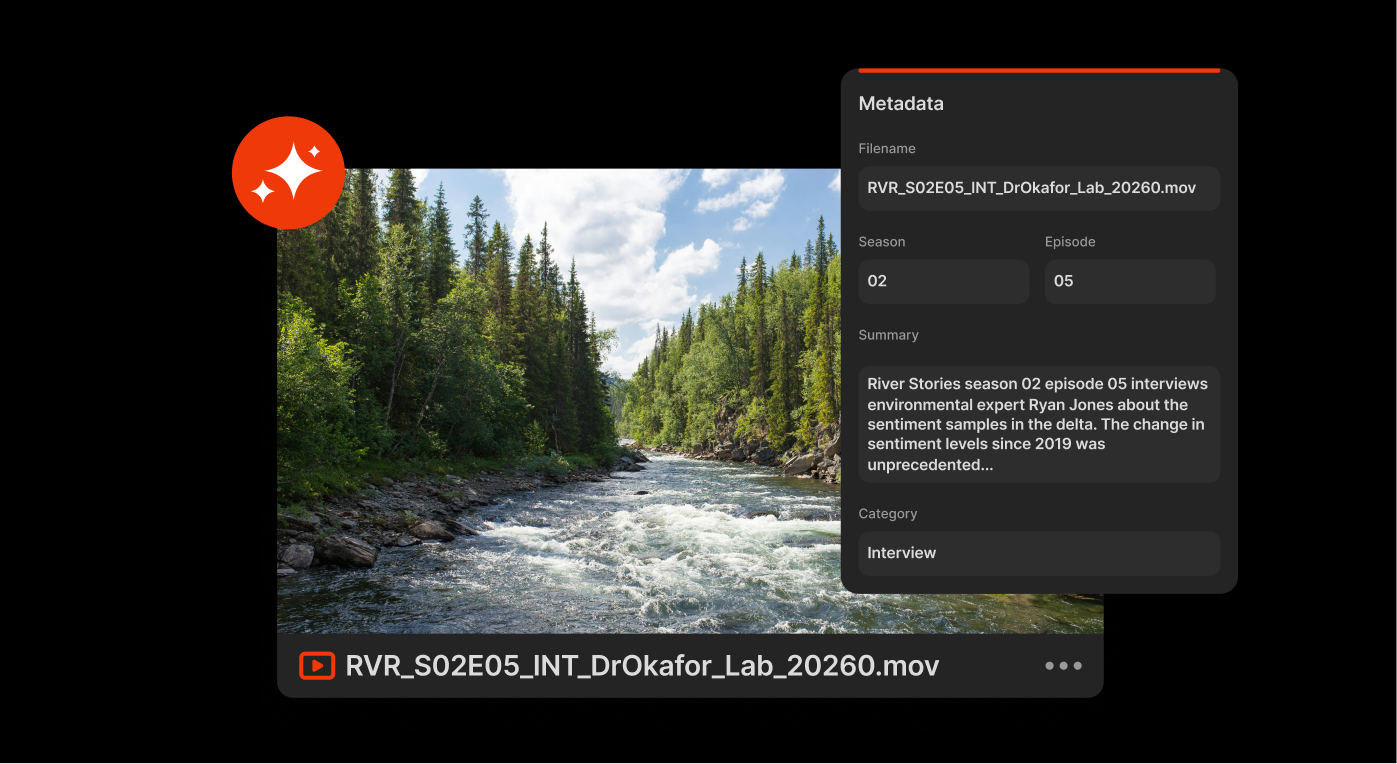
Take one interview clip from a documentary series. (This example is illustrative.) Here's what Iconik already has on it before anyone opens a metadata form:

With an admin's instructions for this library, enrichment can suggest values for the fields the team has chosen:

None of those values required new visual analysis of the footage. Each came from information the team had already produced, just never in a field anyone could filter on.
The intelligence isn't just in the model. It's in the context the organization has accumulated over years of production, and in the expertise of the people who know how to interpret it.
Your experts set the rules
The example works because someone who knows the library told the AI enrichment what INT means and how this team names its files.
Admins can write those instructions once per field: pull season and episode from a naming scheme, write a short description for one storefront and a long one for another, or return a match result as facts instead of a paragraph. Every person who touches an asset afterward benefits from that expertise.
Teams also decide what gets saved. AI enrichment suggests values for the fields an admin has made eligible, and only users with the right permissions can run it. People can review suggestions one by one, accept them in bulk, or choose the fields they trust enough to accept automatically. Existing values are never overwritten.
At The Aspen Group, the team built a field that pulls each asset's project ID and name from its collection hierarchy. Once it worked, they started applying the same pattern to their hard drive library, pulling the drive name and number into their own fields.
“Probably 90% of our metadata entry will be automated” — Mike Miserendino, Sr. Manager, Creative Operations, The Aspen Group
This is what makes the approach useful at scale. Knowledge that once depended on someone remembering a naming convention or manually entering the same information can become a consistent, repeatable process.
Use context before adding processing
There's an economic principle behind this approach.
With today's models, it's technically possible to run extensive analysis on every piece of media. But if the information needed to populate a field already exists in a filename, a metadata record or a transcript, running additional analysis of the underlying media adds cost without necessarily adding value.
Cost-effective AI isn't simply about choosing the least expensive model. It's about avoiding work that doesn't need to happen in the first place. That means making intelligent use of existing context before introducing more computationally intensive analysis.
When a team does need to know what's happening in the frame, Iconik's object and scene detection, facial recognition and partner integrations can provide that additional layer of intelligence. The point isn't to avoid deeper analysis. It's to use the right tool for the question, and make the resulting information available for future use.
That matters particularly for organizations working at volume, where even a small cost per asset multiplies across millions of files. Teams should also be able to forecast what AI will cost before they commit to it. Finance teams don't fund what they can't predict. We believe the right measure of AI innovation isn't how much analysis a model can perform. It's how much useful work it accomplishes, how reliably it does it, and what it costs.
For media teams, the outcomes are tangible: less manual tagging, more consistent metadata, faster asset discovery and greater reuse of existing content.
And the value doesn't stop at better search. When information about a library becomes more structured, consistent and accessible, it also becomes more useful to every other system that connects to it.
That's especially important as AI assistants and agents become a bigger part of everyday work. What an agent can accomplish depends, in large part, on the context it can access.
Connecting your AI tools with the Iconik MCP server
Increasingly, people want to describe what they need and let an AI assistant handle the steps. For that to work in media, the assistant needs access to accurate, structured information about the organization's content.
The Iconik MCP server provides that connection.
Built on the Model Context Protocol (MCP), an open standard for connecting AI tools to external systems, it allows compatible AI assistants and agents to interact with an Iconik library without requiring a custom integration for every tool.
Teams can connect tools such as Claude and other MCP-compatible assistants to search assets and collections, retrieve metadata, transcriptions and comments, and perform supported metadata updates.
Every request runs under the user's own permissions. AI in Iconik inherits the same access controls as the rest of the platform; there's no separate, more permissive access model for AI.
This makes the intelligence in an Iconik library available beyond the Iconik interface itself. And it opens up practical new ways for teams to work with their media.
For example:
- Find footage from a brief. A producer asks for interviews from the spring campaign where the founder discusses sustainability. The assistant searches the library and returns relevant assets and transcript passages.
- Fill metadata gaps. A media manager identifies assets in a collection that are missing descriptions, then works with an AI assistant to draft and update those fields using the library's existing context.
- Prepare for review. A post-production supervisor asks an assistant to retrieve and summarize existing QC issues and comments across a batch of deliverables, making it easier to see what still needs attention.
These are practical examples of what happens when the information managed in a media library becomes accessible to the AI tools people are already using.
What an open, well understood library makes possible
Everything above builds toward the same foundation: a library that’s well described, consistently structured and open to the tools a team chooses to use, including the search tools and AI models it already relies on.
The better a system understands a team’s media, the more of the routine work around that media can be handed off, and the more of the library people can actually draw on. Editors, producers and media managers spend less time hunting for material and filling in fields, and more time on the decisions only they can make.
We’re building toward that deliberately. The longer-term opportunity goes beyond individual requests. As AI agents become more capable of coordinating multistep tasks, media teams will increasingly be able to describe an outcome rather than execute every step themselves.
But useful agentic workflows depend on more than capable models. They need reliable information about the media, connections to the tools that perform the work, and clear boundaries around what an agent is authorized to do. That's why we see metadata intelligence and open connectivity as complementary investments.
A well-described library gives agents the context they need. Open interfaces allow them to work across the systems an organization already uses. And permissions and human oversight provide the controls required to make that automation practical.
The goal isn't automation for its own sake. It's giving media operators more flexibility to determine which work they want to delegate, while keeping them in control of the systems and content they're responsible for.
Your content, your outputs, your control
As AI becomes part of everyday media work, organizations need confidence that adopting these capabilities won't come at the expense of control over their content. We think security and compliance belong in the platform from the start, so they never become the bottleneck for creative work.
Our AI Addendum puts several important commitments in writing.
- Your content isn't used to train AI models without your consent. We will not use customer content to train or fine-tune AI models, or permit third parties to do so, without prior written consent.
- You retain ownership of your intellectual property. Our terms protect customers' intellectual property rights in their inputs and the generative outputs created from them.
- AI is optional. Customers can choose whether to use Iconik's AI capabilities. AI metadata enrichment is administrator-controlled and user-initiated, and teams choose whether suggestions are reviewed one by one, accepted in bulk or accepted automatically for the fields they trust.
- AI follows your permissions. AI metadata enrichment works only on fields a user can already edit, and the MCP server sees only what that user can see.
These commitments reflect a fundamental principle: organizations should be able to benefit from AI without giving up control of the content and information that make their businesses valuable.
And as a library becomes richer, that value builds up in metadata the organization owns, not in a model someone else controls.
We believe the next generation of media workflows will be built on that principle: AI that makes the knowledge organizations already possess more accessible, the tools they already use more capable, and the people doing the work more effective.
That's what we're building at Iconik.
AI Metadata Enrichment is available to all plans. The Iconik MCP server is available on Pro and Enterprise plans.
Explore AI metadata enrichment or connect your AI tools with the Iconik MCP server.

Liz Dellheim leads Product Marketing at Backlight. With over 15 years experience in technology, she specializes in building go-to-market strategies for complex SaaS platforms. Her background spans growth stage start-ups to multinational technology leaders including Samsung and Thoughtworks. Liz holds a BA in Psychology from Barnard College, Columbia University and an MA in Design from Universidad de Los Andes. She lives in New York City.
