.svg)
‘From tool sprawl to creative velocity: Rethinking the modern media stack’ — Key takeaways from our panel with Audible


In this article

Iconik, Audible and AWS in one room: What the panel was about
At the 2026 NAB Show, three people who see the media stack from very different angles sat down to talk about a problem all of their customers share.
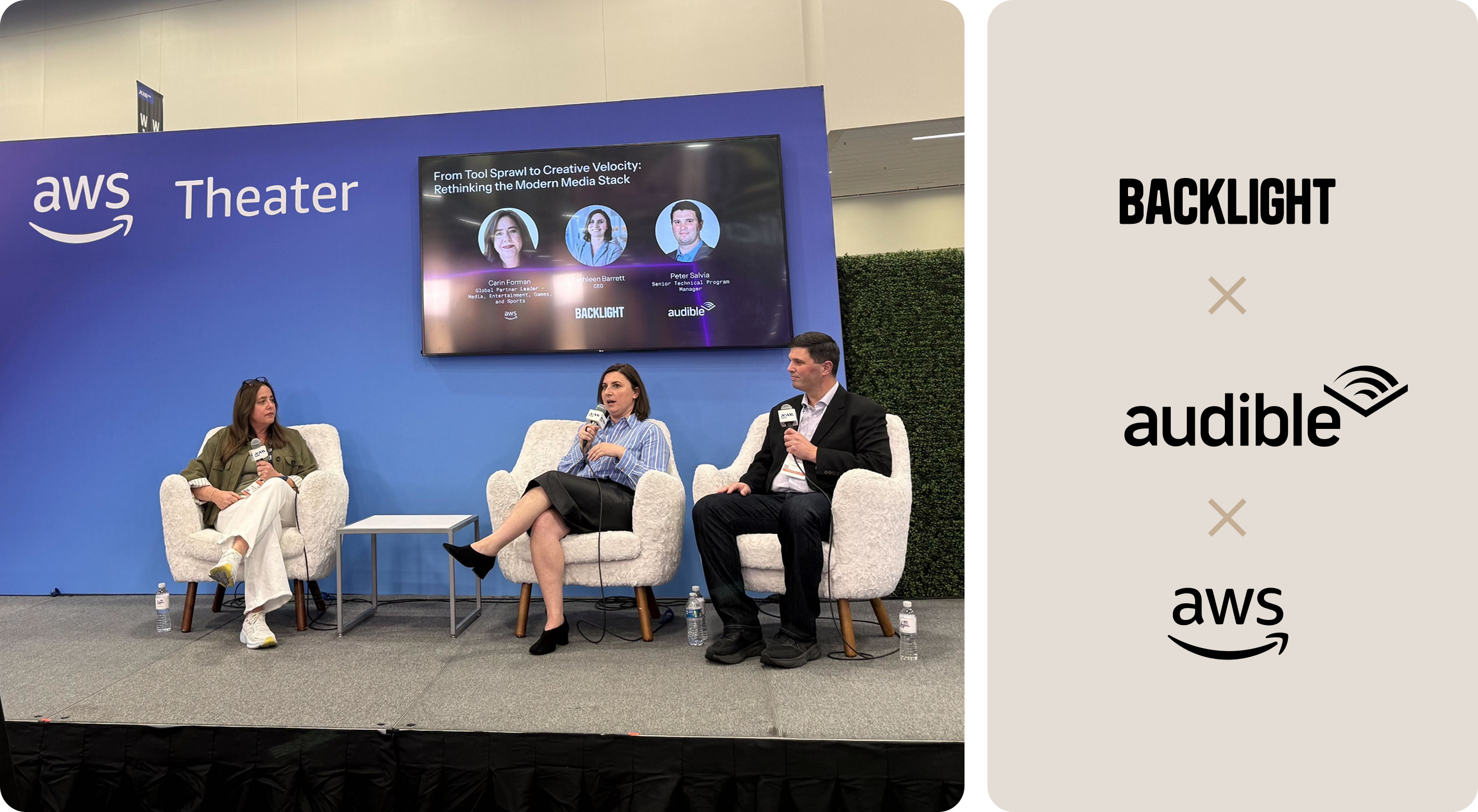
Carin Forman, Global Partner Leader at Amazon Web Services (AWS), moderated. She was joined by Peter Salvia, Senior Technical Program Manager at Audible, and Kathleen Barrett, Chief Executive Officer at Backlight. The session, "From sprawl to creative velocity: rethinking the modern media stack," kept circling one idea: the industry has fallen in love with AI without doing the unglamorous work that makes AI useful.
Every booth on the floor was saying the same word — agentic. Workflows that edit, tag, clip, and distribute on their own. The uncomfortable part? Most teams buying into that vision can't find last quarter's B-roll.
You can't buy your way to an AI-ready workflow. You build the layer underneath it first. For post production leads, media IT leads, and creative operations managers, that ordering is the whole game: get it wrong and every AI tool becomes another silo. Get it right and each one compounds the value of what you already own.
Here are the key points, in the order the panelists made them.
Consolidation is a decision, not a default
Kathleen was direct about how Backlight brings products together across its portfolio, including Iconik for media asset management and Wildmoka for live clipping and distribution.
"We don't want to integrate for integration's sake. We integrate where there's a need to continue the workflow for a single user." — Kathleen Barrett, Chief Executive Officer, Backlight
She sees two patterns on the customer side. First: the team drowning in tools that can't talk to each other.
The second is newer, and more interesting. Teams that deliberately built silos are realizing the value of their media lives in scale, access, and understanding — the exact things silos prevent.
The answer to both is to add a layer of organization above everything they own. That layer is the point. Not another place to put files. A governed, hybrid cloud foundation that makes media organized enough, and findable enough, to actually use.
Change management is the most important part of a media migration
Salvia supports engineering teams whose internal customers span content, marketing, legal, and product organizations across the globe. Rolling out a new platform to teams like that is less a technical project than a trust exercise.
His move is to skip the mandate. He starts by asking teams what they already do, and why they like it.
"We're not trying to break anything. We want to enhance what you're doing." — Peter Salvia, Senior Technical Program Manager, Audible
The mechanics followed from that posture. Clear collections and guardrails inside Iconik, so each team works its own way while sharing content. Regionalized Amazon S3 buckets — storage kept close to each team — so uploads stay fast whether someone's in Japan, France, or New Jersey. Self-service access, including for outside vendors.
"The change management piece is almost as important as your tool selection," Kathleen Barrett, Chief Executive Officer, Backlight
The tell that a rollout is working, Salvia added, is when people stop asking for their old tool and start exploring the new one — because they're looking at their own content inside it.
The platform of the future is flexible by design
Every media IT team fears the same thing: buying a platform that solves today and blocks tomorrow.
Kathleen's answer was architectural. Iconik is API-first and storage-agnostic — it works with whatever storage you already have and connects to the tools you already rely on. It doesn't disrupt the workflow, and it doesn't force one vendor to build everything, because a partner ecosystem fills the specialized gaps.
The discipline is in what ships. A feature has to work at scale and solve for the whole user base — not one customer. Build one-offs, and you're stuck maintaining a platform no one can use well.
The real shift: from making content to activating it
Ask what changed most in the last year and the answer isn't "more AI." It's what teams want AI for.
Kathleen described customers stepping off the content treadmill — less focus on making more, more on driving value from what they already own. Find it, understand it, reuse it. One asset reshaped into many versions, each tuned to a different channel and audience.
Salvia gave the concrete version. Audible's creatives work with thousands of audio assets. With Amazon Transcribe connected, they search for a spoken phrase and jump straight to the timecode where it's said. The hours that used to vanish into "where is it, and does it say what I need" simply go away.
That works because the metadata lives next to the asset. Teams build custom fields and views in Iconik, then bulk-update them — no spreadsheets to reconcile. The payoff is the ability to search media by meaning rather than by filename, across tens of thousands of assets.
As Kathleen put it, people now expect to say what they mean and get the result — and they increasingly believe there's something in their archive they never knew was there. The platform's job is to surface it.
Governance is the price of admission for AI
Here's where the foundation argument closes the loop. The more you want to reuse and activate content — especially with AI in the mix — the more governance you need.
Salvia's teams keep everything in one centralized Amazon S3 pool, and Iconik makes the storage location invisible.
"A user doesn't know if it was uploaded from New Zealand, Germany, or Newark, New Jersey. It all appears in the same place." — Peter Salvia, Senior Technical Program Manager, Audible
Invisible storage is convenient. It's also risky without controls. When teams everywhere can reach everything, you need permissions, roles, rights management, and traceability strong enough to keep that safe — especially once people start feeding content into AI tools. It's the same reason AI and media asset management work best together: the governance layer and the intelligence layer are one investment, not two.
What comes next
Kathleen traced how the AI conversation has changed over two days at NAB. First it was panic. Then "I need an AI vendor in my stack." Now it's "I need to future-proof."
And future-proofing isn't picking the right AI tool. It's laying a foundation — deeper data understanding, governed and accessible media — so whatever arrives next can plug in and pay off. Teams want to be more data-driven without taking the creativity out of the work.
That's the reframe worth keeping. The question isn't "which AI tool should we buy?" It's "is our media ready for any of them?" The teams that can say yes built the foundation first.
Schedule an Iconik demo today to see how a unified media foundation changes the way creative teams find, govern, and activate their content.
Watch the full panel discussion
NAB 2026 — "From sprawl to creative velocity: rethinking the modern media stack"
Read the full session transcript
Transcript lightly edited for clarity and to correct speaker and brand names. Speakers: Carin Forman, Global Partner Leader, AWS; Peter Salvia, Senior Technical Program Manager, Audible; Kathleen Barrett, Chief Executive Officer, Backlight.
Carin Forman (00:04): I'm a Global Partner Leader at AWS. I focus on partner strategy and enablement for partners in the media supply chain space and generative AI. I'm excited to be here with Kathleen and Peter. So let's kick this off with some excitement. Peter, we're going to start with you. Tell us a little bit about your role, what you do at Audible, and the work you're working on.
Peter Salvia (00:30): Thank you, Carin. It's a pleasure to be here. Kathleen, thanks for sitting with me. My name is Peter Salvia. I'm a Senior Technical Program Manager for Audible's Systems Development Engineering team under the tech ops org. At Audible, I support a team of engineers who build and maintain platforms across our global business, and our customers include the content, marketing, legal, and product teams, and more than that too.
Carin Forman (00:54): That's great. And Kathleen, tell us a little bit about your role — it's really interesting, because not only are you the CEO by title, but you work across very large organizations and very small ones, in broadcast, sports, and other areas of publishing. So tell us a little bit about your role.
Kathleen Barrett (01:13): I'm the CEO of Backlight. We build tools that help you unlock the value of your media at scale — help you find it, search it, understand it, and activate that content. A couple of the products are Iconik, our media asset management and collaboration tool, and Wildmoka, our activation layer, which broadcasters also use to take live broadcasts and clip and distribute them at high velocity and scale. We serve a wide range of customers — broadcasters, media and entertainment — but also an interesting, growing segment for us: media teams within corporate brands. So we see a pretty wide range of needs and use cases across our products.
Carin Forman (02:00): With so many products, you've also acquired products under the Backlight umbrella. So this is a bit of a two-parter. As customers, we see system consolidation — people wanting to pull their workloads together. They may have multiple tools in their workload. And you, as a product company, have purchased a lot of companies, and you have to bring your tech stack together. Tell us a little bit about what it's like to bring consolidation together, both in your own tech stack and in what you're seeing from customers who want to pull their workflows together and unify their content supply chain.
Kathleen Barrett (02:40): For us, we don't want to integrate for integration's sake. There were five different products, and we tested the different customer needs and overlaps and how that mapped to our products. So we decided to integrate where there's a need to continue the workflow and the solutions we're providing for a single user. That's why we've been investing a lot of time right now in using our Wildmoka technology in our Iconik platform, extending it beyond a media asset management solution and into distribution. From a customer standpoint, I think of consolidation in two buckets. One is a user that has tons of tools and tons of content and can't find anything. It's very difficult for those tools to talk to each other, and therefore difficult for the team to work together. So they're bringing all of that together under one operating layer, which is often Iconik, and plugging and playing with the other tools that are specialized. This gives them a way to have more seamless handoffs. The other bucket we're seeing — coming up more and more with AI — is companies that made an intentional decision to be siloed, both from a tech standpoint and even in their teams and where their media lives. They're suddenly realizing the value of their media is in that scale, and in the accessibility and understanding of that media. So they're putting in a layer above everything, so they can take advantage of that deeper understanding and activation, and be positioned to take advantage of AI — where you really need that foundational layer organized, governed, and accessible to take advantage of some of these experimental tools that they might want to plug and play and change over time as they evolve pretty rapidly.
Carin Forman (04:23): We're going to come back to that organizational layer, but let's ask Peter a question. Peter, companies themselves are experiencing consolidation in workflows. How do we optimize? You work on a global project — you have podcasts coming in globally — and you had to pull a large user community together to work on the Backlight product, people in multiple countries around the world. What kind of solution guidance did you have to provide your internal customers? What guardrails did you have to put in place? And speak to the complexity, or the opportunity, that change management brought.
Peter Salvia (05:08): Thank you, Carin. You're absolutely right. It was a vast amount of global stakeholders that we were tasked with supporting, and each of these teams is highly efficient, highly talented, with established ways of working. So a step I like to emphasize — one that can get skipped or not considered — is asking them what works for them, what they're doing already, and why they like it. Then, when we evaluate a tool like Iconik, we can show them how this tool builds on what they're already doing and enhances their workflow. You're already a highly effective team. We appreciate the work you're doing. We're not trying to break anything. We want to enhance what you're doing. And when we see the tooling Iconik provides — being able to connect AI, being able to use regionalized Amazon S3 buckets — these are enhancements that help our teams work even more efficiently and reach an even wider audience.
Carin Forman (06:06): Without giving away any secret sauce, can you speak to some of the guidelines you put in place, and how you created a global environment with content coming in from so many different places? How did you create the guidelines so that everyone was operating under the same processes and procedures?
Peter Salvia (06:30): Absolutely. Some of the things we put in place were identifying the organizations within the company and their goals. Once they had their own ways of working clearly defined within the collections that Iconik provides, that put things on rails — guardrails, so to speak — so they could access the content on the regionalized Amazon S3 buckets where they were working. So if you had teams in Japan, France, or the East Coast of the United States, they could access their content quickly, uploading and downloading as needed, and that content would still be accessible to any team in the other global regions. Some of the other best practices we put in place were giving a consistent way of requesting access for new users — making it self-service — and also allowing our partner vendors to access content securely.
Kathleen Barrett (07:27): Peter has one of the most successful programs I've seen rolled out, and he's probably not going to toot his own horn. There was buy-in from the top around the business metrics they were trying to move, but also buy-in from the users — making sure their workflows were intact, and then unlocking incremental value for them. But tons of enablement and education, too. They can self-serve so much information, so they don't feel trapped or held hostage. Supporting your users through a rollout like that is incredibly important, and the change management piece is almost as important as your tool selection.
Peter Salvia (08:05): I'd build on that a little. When you're managing the change management aspect of taking on a new tool, showing your customers their content in the tool — how it looks with the new capabilities and features they haven't experienced yet — helps them feel much more comfortable, much more quickly. They're not looking at an apple and saying, "But I want an orange." They're looking at their audiobooks and saying, "This is how I can interact with this tool, and this is how I can use all the features it brings me." Balancing that with the top-down mandate is about finding a middle way to success, because everybody at the end of the day has to be happy.
Carin Forman (08:47): To double-click on what we just heard: that top-down approach and getting user buy-in are really important. Nobody wants to use new tools or new processes, or go through system consolidation, without that user buy-in. The fact that you've been a marquee customer doing that for Backlight, and the guidelines you put in place, are really instrumental. To share from my previous career before AWS — I was at HBO for 12 years, and when we rolled out one of our first content management systems, we went to the most difficult users first. When we got their buy-in and had them use the system and give us feedback, it took the friction out, almost as a top-down approach, just by having them involved. So I give you both a lot of kudos for that approach. Going in another direction, Kathleen — you're a product company with multiple solutions. You mentioned Wildmoka. You have Ftrack. You have Iconik. You build for many customers: sports, broadcast, studios, publishers. How do you maintain core features and functionality you can service, while also being bespoke and creating a custom experience — so your customers can use the tool in an almost Swiss Army knife, flexible way?
Kathleen Barrett (10:30): There's how the tool was built and functions, and then how we continue to iterate on it — two considerations. One, it's an API-first platform, storage-agnostic, works with any storage you want to bring, and therefore doesn't have to disrupt your workflow. There's a core set of problems we're solving with the product today, and then through the API and integrations you can bring in proprietary data systems and other tools people like, and send information back and forth. It's endlessly flexible and really powerful, so we're always building with that extensibility in mind. We're lucky to have a rich partner ecosystem that solves for things outside our core, so we're not going to go down the path of developing those solutions. On the bespoke and custom side, we get a lot of feature requests. To build a scalable platform, you have to consider whether something will be a scalable feature — one that works in a large environment with larger amounts of assets and scales to all your users, and, importantly, isn't built for only one use case. So we keep a pretty strict filter around what actually makes it into the platform and solves a use case for the entire user base, not just a single customer. Otherwise you're stuck maintaining those things and not providing the right experience.
Peter Salvia (11:54): And if I haven't told you this enough, Kathleen — the API-first approach for Iconik, not just for our users on the platform every day, but for the engineers building and maintaining it. They are so happy when they see the flexibility and specificity of the API. Building and maintaining a platform that's so capable, API-first, is a huge win for them. The other part I want to tout: they also have a customer-first mentality. If I come to Kathleen and say, "There's this one feature that'd be really important," Kathleen listens. We wanted to see documents in a preview — a lot of customers were asking, "Can we just see the Word document? Can we see something other than a PDF? Can we see an Excel sheet? We just want to see what it looks like." And I said, "Kathleen, this one would be a big deal." And sure enough, she came through. Those two things are a one-two punch that's hard to beat.
Kathleen Barrett (12:56): My pleasure.
Carin Forman (13:00): What is your process for bringing in customer requirements and making your tool a Swiss Army knife? Do you have user group meetings? How do you evaluate new feature sets coming into your product?
Kathleen Barrett (13:18): A lot of our customers have direct relationships with even the founders of the business, and with our customer success teams, and have ongoing conversations — because they often start with a very small project and then roll out to other use cases and teams. So we're dynamically involved, and we hear the needs of customers one by one. The team collects that feedback, we look at where there are patterns or more impact, and prioritize based on that. And shows like this are honestly the most valuable thing. We're meeting 300 customers in a row, so you hear the common things folks need, what they're most excited about, and where they're feeling the pain most — and we use that for prioritization as well.
Peter Salvia (14:08): Participating in the collaborations that Iconik and Backlight facilitate is a big win for our teams, because it provides opportunities to learn what other people are doing and work together on things we didn't know we would.
Kathleen Barrett (14:22): We do a fun event with some other customers related to Peter's team, and everybody comes in and presents what they've built on top of Iconik. It's a sharing opportunity. We learn about things they're trying to solve for, they teach each other — it's a really nice, open dynamic.
Carin Forman (14:40): A session wouldn't be a session if we didn't talk about generative AI or agentic workflows. Peter, Audible has a lot of tools and technology. You use Backlight, but you also use tools from AWS, like Amazon Rekognition and Amazon Transcribe. Can you speak to how you use those tools and some of the workflows you're working on with them?
Peter Salvia (15:06): Absolutely. A consistent aha moment for our creatives, who work with thousands and thousands of audio assets, is when they see Amazon Transcribe connected to their audio assets. They can quickly receive a transcription and then search for a word or phrase through the filter search in Iconik. It takes them directly to their audio asset at the timecode it's being said. They've saved — I can't tell you how many hours. It helps them use the content and be creative, instead of focusing on where something is and whether it says what they need it to say. Having the words next to the audio playing back in an interface makes a real difference.
Carin Forman (15:49): Does all that metadata get stored back in Iconik? How does that work? Does it all become searchable metadata so you can get to the exact asset you're trying to find?
Peter Salvia (16:01): Metadata is something I could talk about for far too long. What Iconik facilitates is metadata views and fields — you can customize the fields to whatever your business use case needs. If you have a global team working one way in one region successfully, and another global team working similarly but with slightly different metadata based on language or key performance indicators, they have the flexibility to create those fields the way they want, put them into a view, and then bulk-update them. That takes away the work of managing tables or spreadsheets. It puts the metadata right next to the asset as you're working with it, and it's another way to sort through tens of thousands of assets quickly, based on the tag you want to see, and find what you're looking for.
Carin Forman (16:51): And because you're geographically dispersed, your storage is geographically dispersed. Correct?
Peter Salvia (16:58): We do — hitting all the points here, Carin, this is fun. I can't say enough about how helpful Amazon S3 is as the storage backbone with these globally dispersed teams. Optimizing for teams in the UK, France and Germany, South America, or the East Coast or West Coast — the upload speeds matter. Anybody in the audience would probably look at me and say, "Have you tried uploading a terabyte of data from your desktop to the cloud, and how long does that take?" I have. I'm trying to max out my home internet connection to go as fast as possible. Having the Amazon S3 bucket close to you makes a tremendous difference. That, and Iconik's ability to bring your own storage to the platform — that's a big deal.
Carin Forman (17:47): This one goes back to you, Kathleen. How are your customers approaching the connection between managing content and actually distributing it across multiple platforms?
Kathleen Barrett (17:59): With AI and all these opportunities, what we're hearing from a lot of people is that they're moving toward driving incremental revenue from each piece of content they have. The first step is being able to find everything you have, understanding where it is, and having access to it. The second is really repurposing it — thinking about how you optimize it for different channels and audiences. With different AI tools at play now, it's personalization beyond that. How do you take something a human used to do — take one piece of content and turn it into five — and suddenly make a thousand different versions based on other data you have at your fingertips, to really drive performance? So we're seeing a lot more desire to unlock the value of an archive and the content you've already produced, instead of just focusing on making lots and lots of content. When we think about the platform, it's about enabling that — having visibility and understanding of what you've got, and facilitating integrations with tools that let you manipulate that content and reuse it more effectively. A recent stat came out from AWS that 87% of Gen Z is consuming content on some sort of mobile device, and they're consuming it in so many ways — audio and video.
Carin Forman: Is that changing the way you look at your technology and how you deliver it?
Kathleen Barrett: Absolutely. Wildmoka was very powerful because it could take a live stream and automatically generate lots of clips optimized for delivery on different platforms. But we're also looking at the content itself and asking, how do I rearrange this so when somebody consumes it on TikTok or a different device, it looks like it was made for that device — the right fonts, everything in the right place — and it's not just a cropped version of the original? We've had solutions in place that facilitate that, and we're continuing to invest in making it simpler. Then we see customers go and create content natively for those platforms as well. But this is a great first step: thinking about what needs to be true in that content. How long does it need to be? What does it need to look like? And how do you do that really quickly? Because time is money on those platforms. So we're definitely thinking about making that simpler and taking manual processes out for our users.
Carin Forman (20:36): One thing that's changed quite a bit in the last year is the ability to semantically search archives, and you mentioned how archives are becoming revitalized. Is that changing the way your customers interact with your platform when they're looking at new platforms, new content types, more personalization?
Kathleen Barrett (20:56): Definitely. The expectation is that people want to just say what they mean and get the results. We think of that in a few parts. One is the enrichment of the content itself, so it's searchable — using different contexts we have in the system to create metadata that becomes searchable and actionable. The other part is the natural-language piece. We have really sophisticated and powerful search, but it's very technical to use. So we take a step out and let somebody ask in real language, then translate that to the right search, so it feels much simpler. The third part, with AI and all that buzz: people believe there's something in their archive they didn't know was there, and we have to help them figure out what that means. People are experimenting right now, so the best thing we can do is make it more understood and accessible, and give a deeper understanding of the content at your fingertips. Sometimes that means people looking at transcripts and tying that to audience performance, then iterating on the type of content they make. Sometimes it means finding B-roll or something that's really of the moment when it's trending on TikTok.
Carin Forman: Taking us back to technology — are there themes you can share that you're hearing from the last two days at NAB that are different from what you heard last year?
Kathleen Barrett: If you take that AI thread — it was first, "Oh my God, what's happening?" Then it was, "I have to have an AI vendor in my tech stack." And now it's really, "I have to future-proof," because we're going to have to do more and more in the spirit of agentic media workflows in the future. So, what foundation do I need to put in place today to make sure that tomorrow I'm prepared to take advantage of any other tech that comes to my fingertips? We're seeing a really big demand for that foundational layer — much deeper data understanding — and people want the opportunity to be more data-driven in their media decisions. They don't want to take the creativity out of it, but they want to help people make more informed decisions. That data component has become more and more critical.
Carin Forman (23:15): As a strategist for AWS, data-driven decisions are a significant pattern we're seeing. People have tons of archives, but it's expensive to migrate and digitize them, so they're really looking at those data points. What content are different geographic regions looking at? What content are different demographics looking at? I'd imagine you're both experiencing a creative burst as well, where you can create curated content experiences for your customers, because your content is accessible and you can search on it semantically with natural-language queries. Can you speak to how consumer behavior is changing as a result?
Kathleen Barrett (24:08): Consumers increasingly expect content to feel native. Generic content doesn't resonate. Things that don't look optimized for a platform don't resonate. People want to consume content wherever they feel is most appropriate, and it's no longer enough to be in a single format on a single platform. You're now servicing a more global audience. Overnight, a lot of teams have become globally distributed. What does that mean for translation and context, and what resonates in a region? There's a lot more to learn to optimize for that global delivery.
Peter Salvia (24:47): For our internal users and our partners on the Iconik platform, we see tremendous growth in the use of Amazon S3 storage as a centralized store for all the work they're collaborating on. By keeping everything in an S3 pool, what Iconik does is make it basically invisible to users whether the file is on one S3 bucket or another. It just appears as an Iconik asset. This is part of the magic to me, because a user doesn't know if it was uploaded from New Zealand, Germany, or Newark, New Jersey. It all appears in the same place and is accessible to the teams that have been granted access. That's a big deal.
Kathleen Barrett (25:28): Because of that, accessibility is demanded by all these teams across the globe, regardless of where they are. They want to access everything they have. You need quite a lot of governance and control to make that safe — especially in the world of AI, when people want to reuse this content — so having the right level of protections, controls, and access, which Peter knows well as part of his guardrails.
Carin Forman (25:50): Exactly.
Kathleen Barrett: Exactly.
Carin Forman (25:53): We have about three to five minutes left. Any questions from the audience? We'll be around for a few minutes, so if anyone has questions, we'd love for you to engage. Peter, Kathleen, and I feel we could talk about this subject for hours, so hopefully this was of benefit to everyone. We want to thank you all for coming, because that engagement is what makes this valuable for us. Thank you.
Kathleen Barrett: Thank you, thank you.
Melanie Broder Bashaw is the Lead Writer at Backlight. She has over ten years of experience in SaaS content marketing and has written for brands such as Wistia, MongoDB, WhatsApp, Padlet and Slite. Her creative writing has been published by the Common and Public Books. She has an MFA in writing from Columbia University and is based in Los Angeles.

